

Let’s have an honest conversation, the kind most branding articles won’t have with you.
Picture this scenario: you are a small business owner who has had some success in the past. Your friends have referred you to wonderful clients, but you feel deep within you that something is still lacking in your business.
So what do you do next?
You make plans, spend months, and a significant portion of your budget working with a brand designer. You completely trust this designer, who was highly recommended by a friend who is doing exceptionally well in their business.
You get a sleek new logo, a beautiful color palette, and a professionally built website. You even go the extra mile by creating ads for visibility, but despite all that effort and time, nothing much happens. There is no traction on your website. You jump on every social media trend, and still, Forbes hasn’t requested an interview with you.
You are now the aesthetically pleasing brand with no revenue.
If this has ever been your situation, you are not alone. This happens to more small and growing businesses than people realize.
By now, you may have noticed that the problem wasn’t necessarily your logo or your colors. Often, the bigger issue is the brand strategy underneath them. When your brand strategy is well thought through, it gives your business a stronger foundation for attracting the right audience and communicating why they should choose you.
Your brand strategy should call your customers by name, every time, without missing anyone.
Branding is not just about how a business looks visually. It’s about how a business positions itself to grow. To understand why so many businesses struggle here, we first need to understand what brand strategy actually is.
What Brand Strategy Really Is
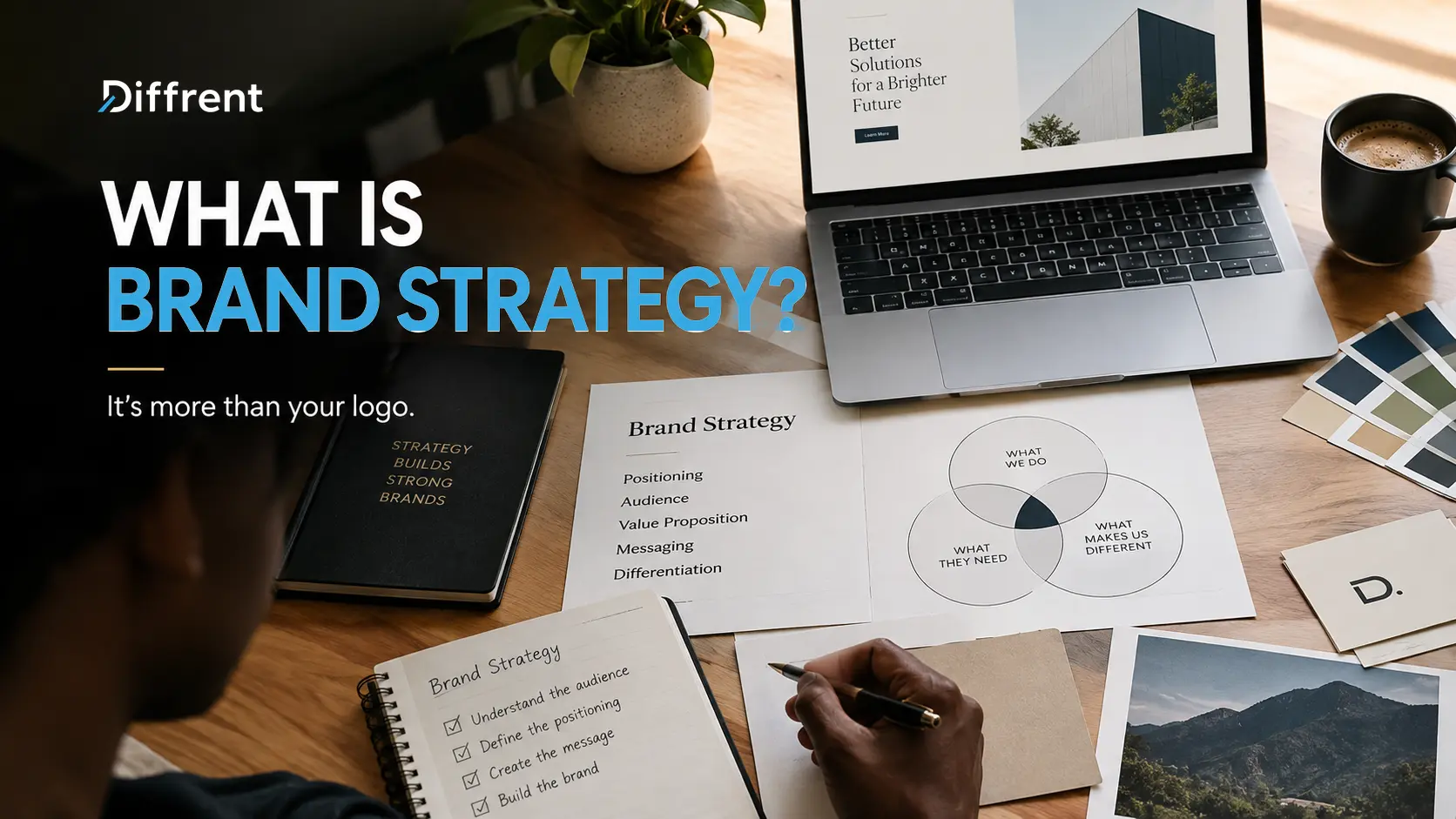
Brand strategy is the foundation underneath a strong brand. It’s not a mood board or a font choice. It’s a strategic framework that answers some of the most fundamental questions a business can ask about itself:
-
Who exactly are we serving?
-
What problem do we solve for them?
-
What makes us different from everyone else who does something similar?
-
How should we communicate with our audience in a way that connects with them?
These questions may sound simple, but they have significant implications for how a business presents itself and makes decisions.
When a brand can answer these questions clearly and consistently, everything else, including the design, messaging, and marketing, has something solid to work from.
Let’s take Coca-Cola as a case study.
Coca-Cola has been in existence since 1886 and has stayed remarkably consistent for well over a century. In that time, almost everything around marketing has changed. Technology has changed. Advertising platforms have changed. Consumer behavior has changed.
Just a few decades ago, if you wanted to advertise your product to a broader audience, you needed to go to a TV or radio station, create a jingle, and pay for airtime. Now, you can reach a wider audience from the comfort of your home through social media ads.
Through all these changes, Coca-Cola’s core brand has stayed recognizable. When you see a Coca-Cola bottle or advertisement, you can often recognize the brand through its distinct red color, familiar script logo, and overall visual identity.
But that consistency is not simply about keeping the same logo.
Coca-Cola has built a brand around ideas that go beyond the drink itself: refreshment, happiness, connection, and shared moments. In many of its campaigns, the drink isn’t the main story. People are.
You see friends watching a game together. Families celebrating. People sharing an ordinary moment. The product becomes part of the experience, rather than the entire story.
That is what makes the example useful.
Coca-Cola’s campaigns can change with the times without forcing the brand to start from scratch every time. The creative execution can evolve, but the underlying brand idea remains recognizable.
That is the role strategy plays.
Think of it this way: design expresses the brand, and brand strategy defines it.
Without a strategy, a brand can become a collection of aesthetic choices hoping to mean something. With strategy, every color, every word, and every campaign decision has a purpose.
That’s the difference between a brand that looks good and a brand that works.
Why Branding Gets Reduced to Design
So if brand strategy is so important, why do so many conversations about branding get reduced to colors and logos?
The answer is simple: visual elements are the easiest part of a brand to see.
When someone asks, “What does your brand look like?” you can show them a logo.
When someone asks, “What does your brand stand for?” that takes more thought.
For many business owners, that deeper question has never been fully worked through.
The branding industry itself shares some responsibility here. A lot of branding content focuses heavily on aesthetics: typography trends, color psychology, and design systems.
These are important, yes, but they represent only the surface layer of what branding actually involves.
Voxco cites an average of 10 seconds for consumers to form a perception of a brand. That first impression can certainly be influenced by what people see, but the relationship with a brand doesn’t end with the first impression. Consistent communication, the experience people have with the business, and the trust built over time all contribute to how that brand is ultimately perceived.
Design is important. Nobody is arguing otherwise.
Design works best when it is guided, informed, and grounded in brand strategy. Without that foundation, even the most beautiful brand can struggle to communicate what makes the business worth choosing.
The Role of Brand Strategy in Business Growth
Remember the scenario we pictured earlier? A business with good products, warm service, a decent logo, but flat results and no real sense of who you were actually talking to or why anyone should choose you over the competitor two streets away.
Now imagine you paused, did the strategic work, and got specific.
You weren’t just another option in the market. You were the option for a very particular person with a very particular need.
With a clearly defined brand strategy, growth becomes less of a guessing game because your decisions have something to work from.
This doesn’t mean brand strategy magically produces revenue. Business growth is influenced by many things, including the quality of the offer, pricing, sales, operations, customer experience, market conditions, and marketing execution.
What brand strategy can do is give those activities a stronger strategic foundation.
Research from McKinsey & Company has found a relationship between growth and the integration of creativity, analytics, and purpose. In its research, companies using all three together recorded average growth rates significantly above companies that did not, although this research should not be interpreted as proof that brand strategy alone causes revenue growth.
Here’s how brand strategy can help your business:
-
Clear market positioning: When you know exactly who you serve and what makes you different, you can occupy a specific place in the market rather than trying to appeal to everyone and resonate with no one.
-
More effective communication: Strategy gives you the language to describe your value in a way that connects with the people you’re trying to reach. You no longer have to struggle to explain what you do.
-
Attracting the right audience: A strategically built brand can make it easier for the right people to recognize that your business is for them. It can also discourage poor-fit enquiries.
-
Building trust and recognition: Consistency is one of the most underrated assets available to any business. When your messaging, tone, and values show up consistently, people have more opportunities to recognize and understand what your brand stands for.
-
Focused, efficient marketing: When your strategy is clear, marketing has a stronger direction. You know what to say, where to say it, and who you’re saying it to.
Signs Your Business May Be Missing a Brand Strategy
At this point, let’s do a simple exercise. Pick up something to write on, and as we go through the list below, assign either a yes or a no to each item.
Are you ready? Let’s go.
Yes or no?
-
Your messaging is inconsistent: What you say on your website, your social media, and in conversations with potential clients doesn’t quite line up. Each touchpoint feels slightly different.
-
You struggle to explain what you do: You know your work inside out, but when someone asks what your business does, you find yourself fumbling for the right words.
-
Your marketing feels scattered: You’re trying different things, posting here, running ads there, trying a new platform, but nothing feels cohesive or particularly effective.
-
You’re attracting the wrong audience: Enquiries come in, but they’re from people who aren’t a good fit, can’t afford your services, or don’t really understand what you offer.
-
You compete mainly on price: Without a clear sense of what makes your brand different, price has become your default differentiator.
-
You’ve rebranded visually more than once in the past year: You changed your visuals because a fresh coat of design paint seemed like the solution, but nothing really changed in the business.
Exercise over!
For participating honestly, your business thanks you.
How many yeses did you count?
If several of those sounded familiar, your next move may not need to be another logo, another website, or another marketing platform. It may be time to step back and look at the strategy underneath the brand.
What a Strong Brand Strategy Includes
A well-built brand strategy isn’t a single document or a one-hour workshop. It’s a comprehensive framework that gives a business the direction it needs to grow with intention.
Here’s what that typically looks like:
-
Brand Positioning: The specific place your brand occupies in the minds of your target audience, relative to competitors. What do you want to be known for, and by whom?
-
Ideal Customer Definition: A deep, specific understanding of who you’re trying to reach: their challenges, their goals, their decision-making process, and what they value in a solution like yours.
-
Value Proposition: A clear articulation of the unique value your business delivers, and why that matters to your ideal customer.
-
Brand Messaging: The core messages that communicate your brand’s purpose, positioning, and value across all channels, consistently.
-
Brand Voice and Personality: The tone and character your brand brings to every interaction. Are you authoritative? Warm and approachable? Bold and direct? This guides every word you write.
-
Competitive Differentiation: A clear understanding of what makes your brand genuinely different from others in your space, beyond surface-level claims like “quality” or “great service.”
When all of these elements work together, every part of the brand, including design, copy, campaigns, and customer experience, can point in the same direction.
Strategy Should Always Come Before Design
By now, you understand that brand strategy is far more than visuals.
This is the core of everything we’ve covered: strategy should come before design, always.
A useful way to think about it is to imagine building a house. Before a single brick is laid, there’s a blueprint: detailed plans that define the structure, the flow, the purpose of every room, and how everything fits together.
The construction team doesn’t guess what size a room should be. They follow the blueprint.
Your brand strategy is your blueprint. If it is not detailed, you cannot build properly.
Without a blueprint, you might still end up with something that looks like a house, but rooms might not connect logically, space might be wasted, and things that should work together won’t. At some point, you’ll need to tear things down and start again.
This is exactly what can happen when businesses invest heavily in design, websites, marketing, and ads before developing their strategy.
The visual brand might be attractive, but it may lack the strategic direction needed to support the business.
Starting with brand strategy means that when the design work begins, the designer has direction. They aren’t being asked to make something beautiful and then figure out what it is supposed to communicate afterward.
That’s how brands are built to last.
Conclusion
Before we wrap up, take this with you.
Brand strategy isn’t an optional extra for businesses that can afford to think about it. It’s the foundation that many of the decisions around your brand should be built on, especially when you’re investing heavily in design or marketing.
Before your next branding or marketing investment, sit with a few honest questions:
-
Who are we really trying to reach?
-
What do we want to be known for?
-
What genuinely makes our brand different?
